 |
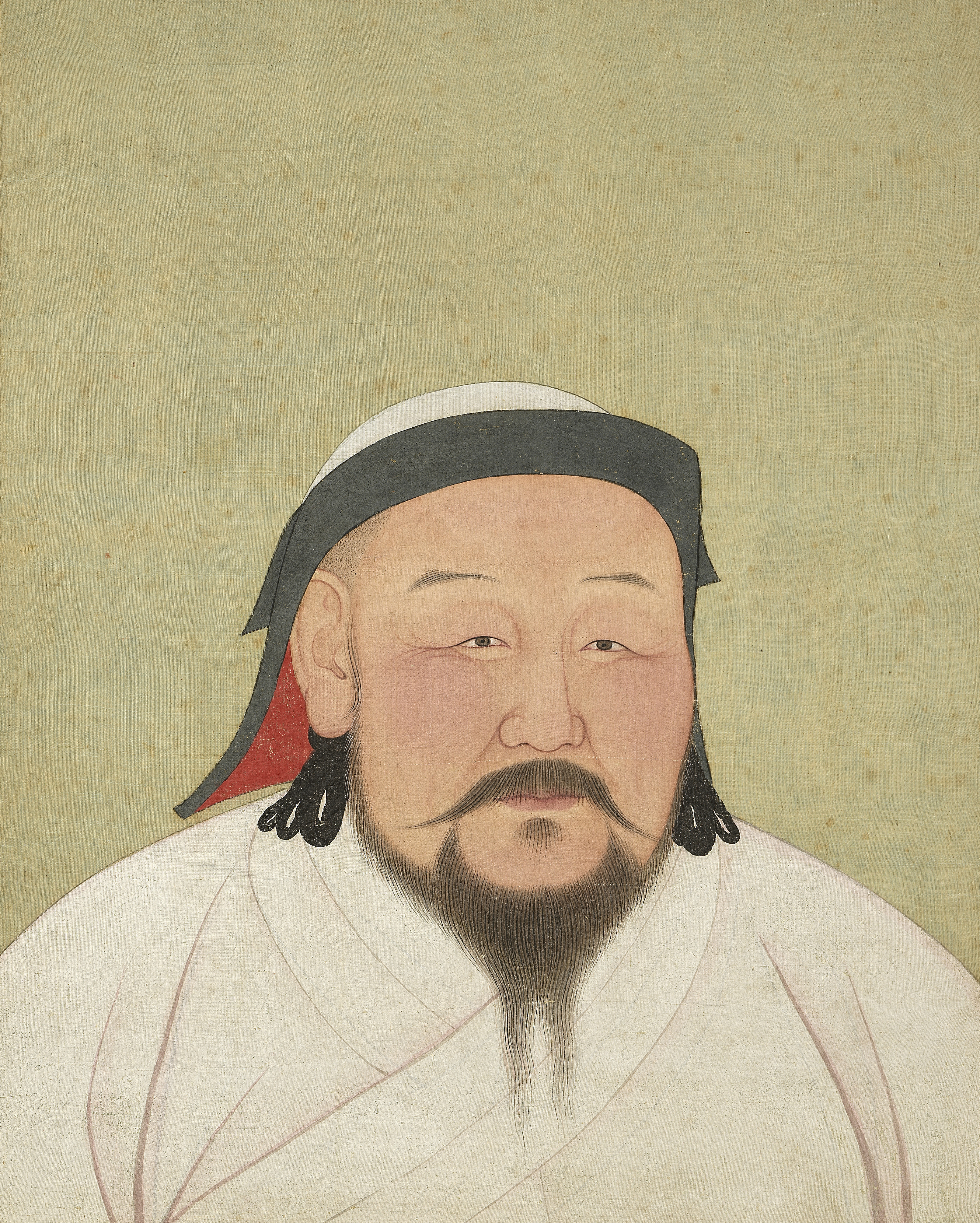
| A painting of Kublai Khan, as he would have appeared in the 1260s by a Nepalese artist and astronomer Anige. |
Neo-Confucianism :attempt to create a more rationalist and secular form of Confucianism by rejecting superstitious and mystical elements of Daoism and Buddhism that had influenced Confucianism during and after the Han Dynasty.
Porcelain : a ceramic material made by heating materials. The manufacture of porcelain became highly organized and the kiln sites excavated from this period could fire as many as 25,000 wares. Some porcelains were more highly valued than others in imperial China. We can identify the most valued types by their association with the court, either as tribute offerings, or as products of kilns under imperial supervision.
Mongol : The Mongol Empire emerged from the unification of nomadic tribes in the Mongolia homeland under the leadership of Genghis Khan, who was proclaimed ruler of all Mongols in 1206. The empire grew rapidly under his rule and then under his descendants, who sent invasions in every direction.
Yuan : was the empire or ruling dynasty of China established by Kublai Khan, leader of the Mongolian Borjigin clan. Although the Mongols had ruled territories including today's North China for decades, it was not until 1271 that Kublai Khan officially proclaimed the dynasty in the traditional Chinese style. The Yuan dynasty is considered both a successor to the Mongol Empire and an imperial Chinese dynasty. It was the khanate ruled by the successors of Möngke Khan after the division of the Mongol Empire. In official Chinese histories, the Yuan dynasty bore the Mandate of Heaven.
Khubilai Khan : was the fifth Khagan (Great Khan) of the Mongol Empire (Ikh Mongol Uls), reigning from 1260 to 1294, although it was only nominally due to the division of the empire. He also founded the Yuan dynasty in China as a conquest dynasty in 1271, and ruled as the first Yuan emperor until his death in 1294.
Marco Polo : Dictated The Travels of Marco Polo/The Description of the World to his cell mate who wrote it. He was born in 18th century into a wealthy merchant family. While traveling east, he was welcome by Kublai Khan to China and Kublai Khan entrust him to bring back more about Christianity and 100 Priests and Holy Oil. He served as an adviser for Kublai Khan when he came back to China the second time around.

No comments:
Post a Comment